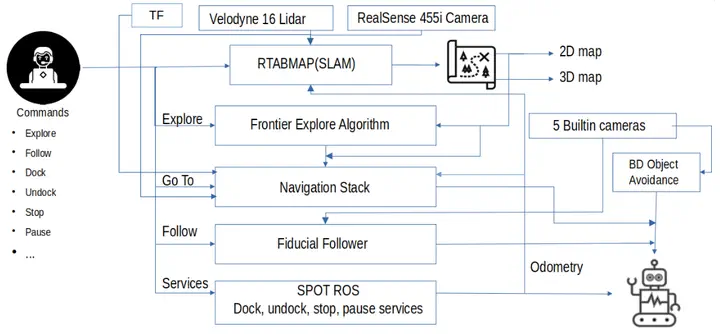
 Systems Architecture
Abstract
Autonomous task-oriented robots are increasingly in demand across various domains; however, few existing systems address the challenge of autonomous high-resolution terrestrial scanning for construction and inspection purposes. This paper presents a task-oriented autonomy framework integrated with the Spot quadruped robot, enabling autonomous exploration, mapping, and deployment of a FARO terrestrial laser scanner. We introduce two novel algorithms for selecting optimal scanning positions: SCANSAFE (Scanpoint Navigator using Spatially-Aware Filtering and Evaluation), which prioritizes coverage of open space relative to prior scans, and PATHSAFE – Path-Aligned Trajectory Heuristic for Scanpoint Allocation with Filtering and Evaluation method, which places scan points along the robot’s traveled path. These approaches are evaluated against two existing strategies: Next-Best-View Greedy (NBV-Greedy) and Frontier, as well as a manually guided baseline. Tested in multiple environments, the proposed algorithms successfully identified valid scanning points. On average, the SCANSAFE method generated 23.4% fewer scan points than NBV-Greedy, 44.4% fewer than Frontier, and 2.0% more than the manual baseline. The PATHSAFE method showed average reductions of 32.8% compared to NBV-Greedy, 51.6% compared to Frontier, and 10.4% compared to the manual approach. Both methods improved efficiency, reduced operational overhead, and increased safety in hazardous or constrained environments.